
AI as an Employee
Have you ever gone to sleep without giving a single instruction, only to find that things had been done by morning?
Riding the Giant Wave Called AI
AI is advancing day by day and spreading across every industry. Jensen Huang, CEO of NVIDIA, declared the current explosive transformation to be “the beginning of a new industrial revolution,” while Sundar Pichai, CEO of Google, asserted that AI “will have a more profound impact than fire or electricity” in human history.
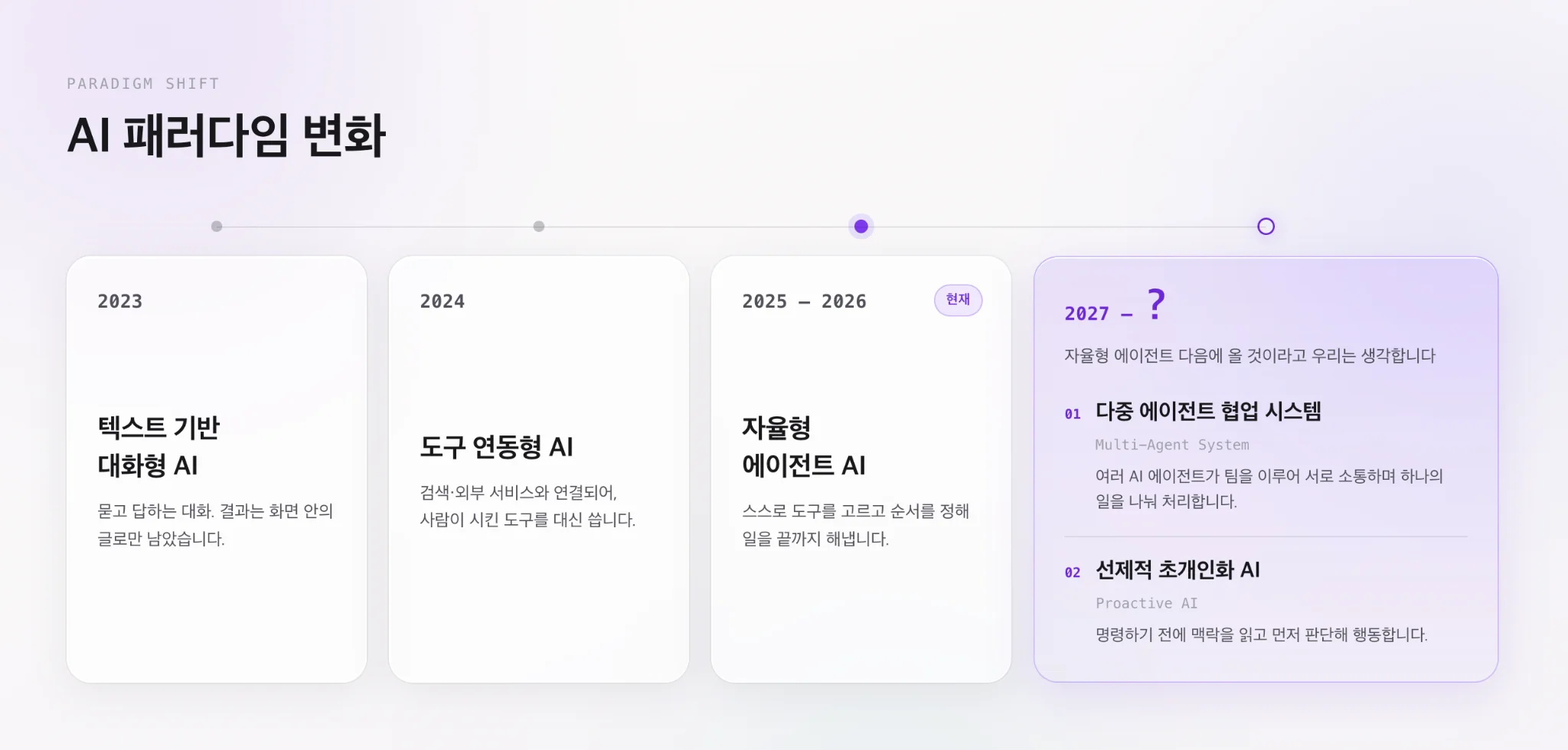
November 30, 2022. It has been less than four years since ChatGPT was released to the public, yet the AI paradigm is changing rapidly.
- 2023: Text-based conversational AI
- 2024: Tool-integrated AI
- 2025-2026: Autonomous agent AI
- 2027 ~ : [?]
We believe that “Multi-Agent Systems” and “Proactive AI” will follow autonomous agents. Multiple AI agents will form teams, communicate, and work together, and they will act before being instructed.
Already, the software market has been completely transformed by autonomous agent AI alone, and this change is beginning to affect every adjacent industry. Developers and designers are navigating this giant wave.
The Difference Between a Tool and an Employee
Until now, we have used AI only as a tool. We ask ChatGPT a question, copy its response, paste it into our materials, and revise it. Or we type similar prompts every time we need to research something, adjusting the prompt for better results. Writing better prompts led to better outputs, and this was often hailed as a new-generation skill. This paradigm will become a relic of the past.
Now, AI will be elevated from a tool to a colleague, collaborating with people and integrating into businesses. The process is the same as with a human employee. You hire a new AI employee, explain the work in detail, and provide any relevant documents. If you provide feedback on the AI employee’s work during the first 3-5 tasks, it will gradually require less and less feedback over time. You can experience this new paradigm with UpServe.
Over the past 30 days, UpServe’s open beta recorded approximately 50,000 LLM calls. Of these, only 16,000 were initiated by a person, just 32%. The remaining two-thirds were tasks carried out autonomously by agents through schedules, heartbeats, and other mechanisms. During the time they run autonomously, agents review past actions and refine their workflows.
Leave the routine tasks to your agents, step back, and become a manager who oversees the work as a whole.
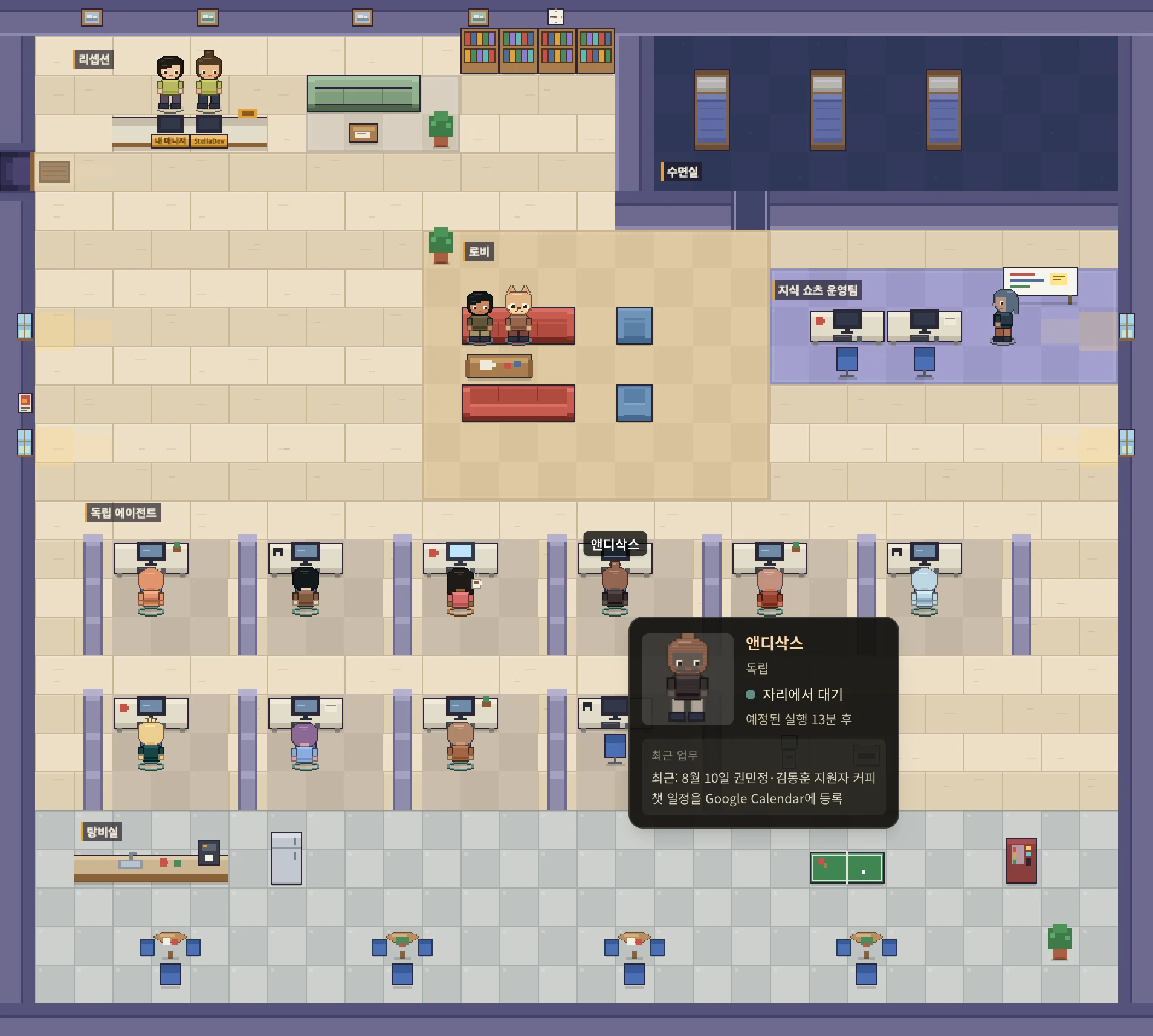
If It Were an Employee, You’d Pay a Salary
If you were to hire an employee to handle an overwhelming workload, how should you calculate the cost? Beyond salary, there are offices, PCs, desks, various work tools, and countless other factors to consider. As you know, AI operates at a much lower cost. As a result, OpenClaw and Hermes Agent have attracted attention and are even being deployed in real-world work. However, they require separate hardware (e.g., a Mac Mini), as well as infrastructure setup, agent configuration, mobile integration, and multi-step processes. In addition, because they use an individual’s LLM provider API key on a pay-as-you-go basis, they become more expensive the more you use them.
UpServe has moved all infrastructure to the cloud. Simply sign up, and you can immediately create agents by chatting with a manager. With the Enterprise plan, we provide unlimited usage within the contracted scope of work for your automation requirements.
Even so, some customers do not have the time to create agents themselves. Through our Enterprise plan, we also offer a setup service in which a dedicated engineer handles your requirements and builds agents directly in your account.
By adopting UpServe for work that would otherwise require hiring a human employee, you can save up to 80-90% in costs.
What’s Still Missing
We do not claim that our agents are perfect. As “new employees,” they need time to be trained to suit the nature and “preferences” of your work, and there are still areas of certain administrative tasks that AI cannot handle.
UpServe agents promise to cover up to 70% of your work at 10-20% of the cost of a human employee.
With the rapid advancement of LLM models, we are witnessing that 70% figure grow higher every month. This number will soon rise to 75%, 80%, and beyond, and we are confident that a future will ultimately arrive in which agents exceed 100% and guarantee higher performance than human employees.
Design your business to be Agent Driven in advance and prepare for the future ahead. UpServe will be there to support you.
Before You Hire
There are still areas where people are needed. For example, even if agents are deployed across a variety of tasks, work onboarding and result review management have not yet been replaced. Even if you have a manager agent, its performance still needs to be managed by a person.
However, if you are considering hiring now, before you hire, take a moment to ask yourself:
Why not check whether an AI employee can help your business?
Inquire About Hiring an AI Employee ➜
StellaDev Co., Ltd. (operator of UpServe), CEO Ha Yong-wook